Key Dates:
- July 1972 – Work begins on embankment for South approach road
- March 1973 – Work begins on sub-structure
- April 1973 – Work begins on superstructure
- May 1974 – Hessle Tower topped out
- March 1975 – Box assembly begins in Priory Yard
- September 1975 – Barton Tower pier caissons founded
- March 1976 – Barton Tower pier completed
- July 1976 – Barton Tower topped out
- September 1977 – Cable spinning begins
- July 1979 – Cable spinning completed
- October 1979 – First boxes erected
- July 1980 – Last box erected
- September 1980 – Laying wearing surface (mastic asphalt) begins
- June 1981 – First open to traffic
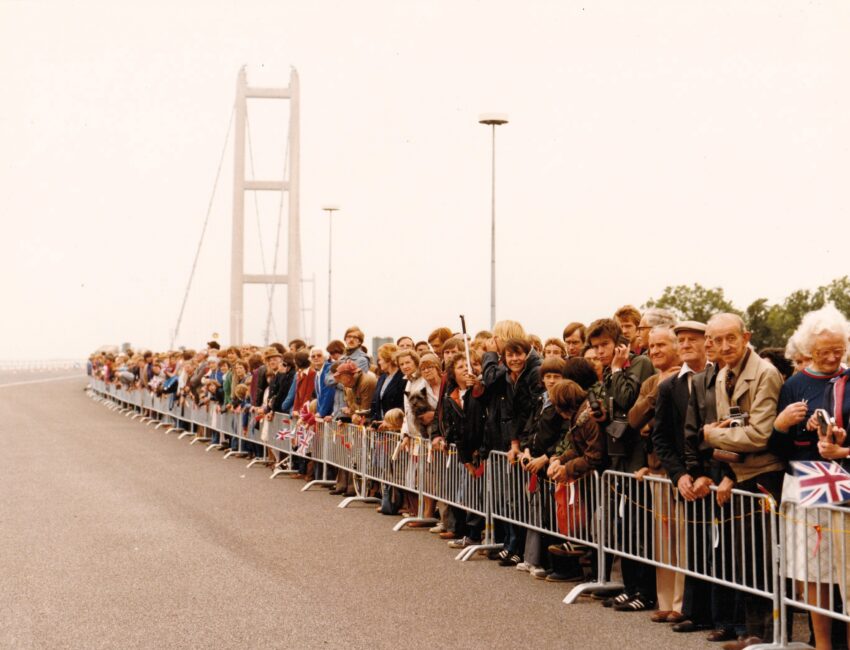
- July 1981 – Officially opened by Her Late Majesty Queen Elizabeth II
After the Construction
The bridge was officially opened by Her Late Majesty Queen Elizabeth II on 17th July 1981. In the years following, the bridge has played a central role in shaping the region’s future, by bringing people and places closer together, supporting growth, and making everyday life more connected, convenient, and sustainable. Travel between towns became much quicker, with some road journeys shortened by up to 60 miles. Along with its connecting roads, the bridge formed part of a broader transport network, linking East Yorkshire and North Lincolnshire to the national road system.
Economically, the bridge continues to bring lasting benefits. By linking the north and south banks, it helped the wider Humberside region begin to realise its potential; opening up opportunities for industry, commerce, and tourism. It makes transporting goods and services more efficient, reduces costs for businesses, and encourages new investment in the region. It also supports job creation, through ongoing maintenance and the growth it enables.
The social impact is equally important. Communities that were once separated by the estuary are now more closely connected. People enjoy easier access to work, schools, healthcare, and leisure, making everyday life simpler and more flexible. The bridge also attracts visitors to the region, boosting local tourism and hospitality.
From an environmental perspective, the bridge helps reduce fuel use and vehicle emissions by eliminating the need for long detours around the estuary. The more direct travel route supports efforts to make transport in the area more sustainable.
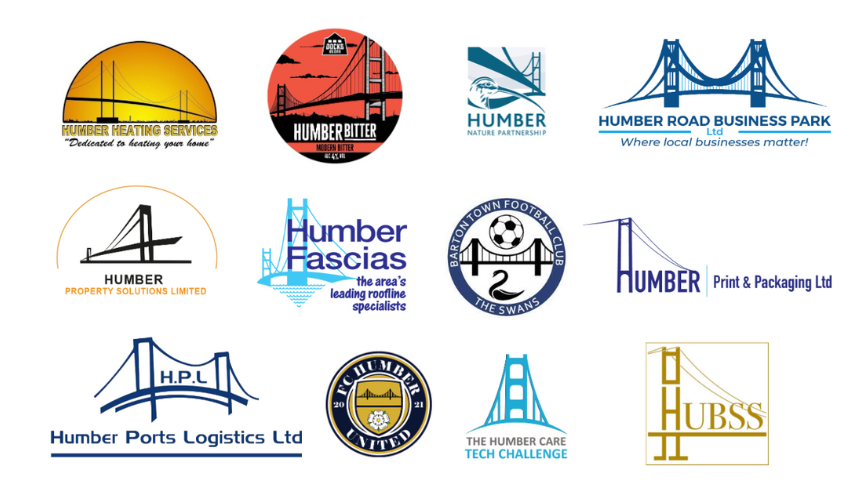
The bridge has also become a powerful symbol of regional identity. Its striking silhouette is used as a backdrop in news broadcasts, featured in promotional materials, and incorporated into the logos of many local businesses. It serves not only as a feat of modern British engineering, but also as an emblem of pride, progress, and connection for communities on both sides of the Humber.
Pictured: some of the many logos of local companies which prominently feature the Humber Bridge.